The new 2017 Ducati SuperSport and SuperSport S have been revealed. The new model aims to be a practical option for everyday riding. But still able to be sporty when you want it to be.

It’s a tricky balance to pull off. The danger is that you might end up with something that does neither role particularly well.
Ducati have based the 2017 SuperSport around the same 937cc Testastretta 11 degree engine as you find in the Hypermotard. Except that the 113hp liquid-cooled engine has had a redesigned crankcase and cylinder heads. That allows it to become a fully-stressed part of the trellis frame. The coolant has also been re-routed through the cylinder heads and a new gear sensor has been added. Changes to the intake and exhaust system also mean the power comes low down, with 71 ftlb of torque at just 3,000rpm. But the new 2017 Ducati SuperSport and SuperSport S also feature longer final drive ratios for a suitably higher top speed than the Hypermotard. It makes sense for something which is more likely to be touring at a higher speed when it’s not on a track or B road.

But rather than slapping a fairing onto the Hypermotard, the Ducati engineers created a whole new bike around the engine. That means they’ve combined more relaxed ergonomics for riders and pillions, with similar geometry to the Ducati Panigale. So it really should be agile and quick handling, with a possible 48 degrees of lean.
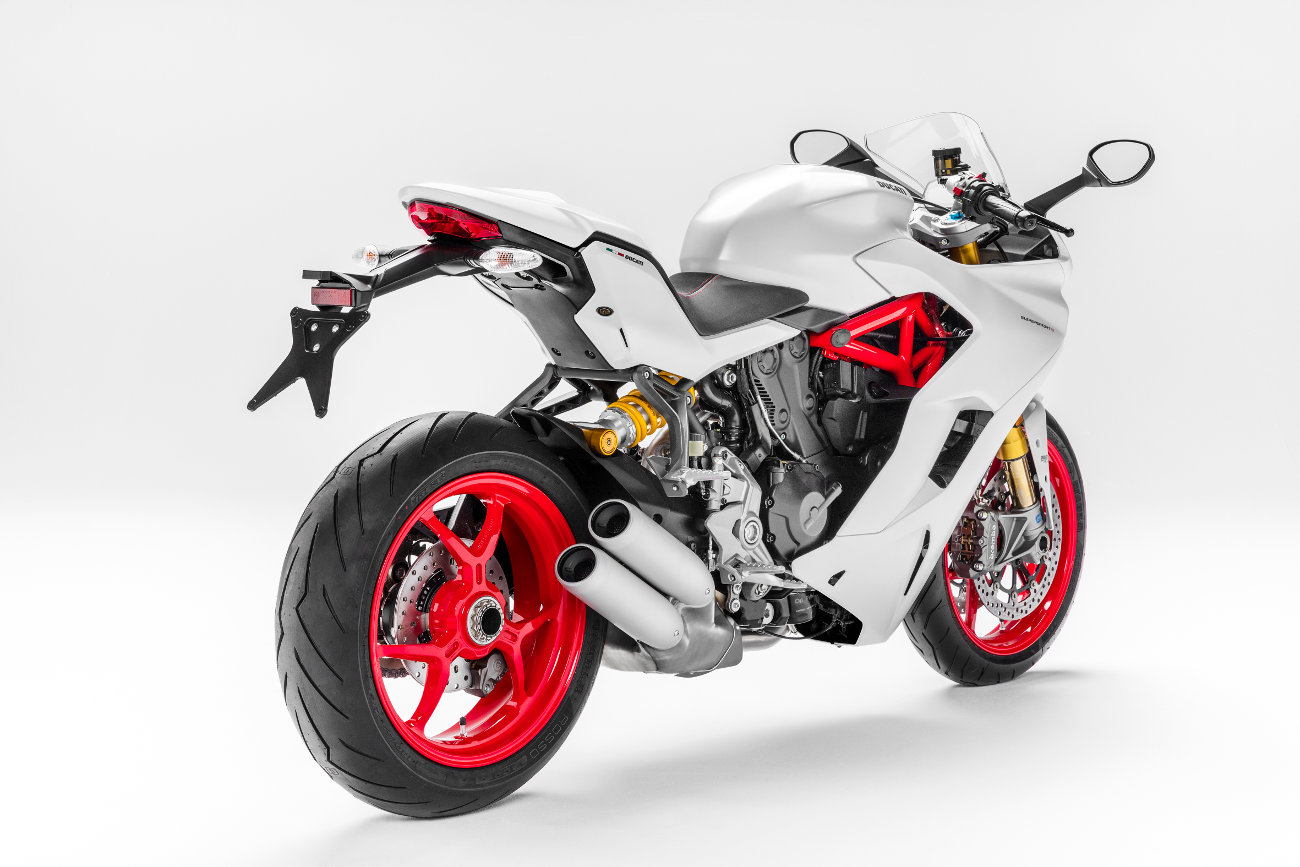
So it should cover the sportier side of the promised combination with the expected Ducati aplomb. But it also needs to be versatile. You expect the Ohlins suspension on the S model to be fully adjustable. But the base SuperSport also gets fully adjustable Marzocchi forks and a Sachs shock with variable spring preload and rebound damping.
The seat height is 810 mm as standard. But it can be increased or reduced by fitting an alternate Ducati accessory seat unit – lifting or lowering it by 20mm. And the screen also has two positions, with 50mm of variation in height.

There are also some thoughtful touches to the new 2017 Ducati SuperSport and SuperSport S. You get LED daylight running lights similar to the Panigale, but the headlights are actually contained in the front air scoops, which is an unusual look.
Ducati claim to have tested the pillion seat for 30,000km already. So the seat should be comfortable, and there are integrated grab rails under the tail unit. But you can also fit an optional Ducati accessory grab rail if it’s needed.
The 16 litre fuel tank is steel, which is useful if you want to fit a magnetic tank bag. And along with a longer wheelbase than the Panigale for stability, the SuperSport also gets a unique single-sided swingarm and wheels.

You get the Ducati Safety Pack as standard with Bosch ABS and Ducati Traction Control. And there are three Riding Modes to adjust the bike to Sport, Touring and Urban characteristics.
The new 2017 Ducati SuperSport will cost £10,995 ($12,995 in the U.S)
Spending the extra on the 2017 Ducati SuperSport S will upgrade you to fully adjustable Ohlins suspension, a Ducati Quick Shift up/down system, and a rear seat cover. That will cost you £12,295 for the Red colour option ($14,795 in the U.S). A Ducati SuperSport S in Silk White costs £12,495.

If you do buy a new 2017 Ducati SuperSport and want to upgrade to an S later, all the parts will be available buy and add separately. Interestingly, the Italian firm expect to sell more standard machines than the upgraded version, with a 60-40 split being the opposite of what you normal find for Ducati sales. Mind you, they’re also predicting bigger sales than for the 959 Panigale, so they’re not short on optimism.
The question is whether potential buyers will want to spend more than £10,000 on something which sits between two stools. Then again, if the Honda VFR can sell on the slightly more touring side at a similar price to the base SuperSport, then perhaps Ducati might be onto something. And when it comes to sportier motorcycles, there’s a gap about to appear where the 600cc middleweight sports bikes were sat until low sales and Euro4 standards made them unfeasible to develop. And it’s certainly in a different level of style to the new mainstream sporty/touring road bikes.
The more I think about it, the more the new 2017 Ducati SuperSport and SuperSport S seem like they might not only be viable, but quite a logical choice.
The Ducati SuperSport Name:
The SuperSport moniker was originally applied as two words to racing prototypes raced by Paul Smart and Bruno Spaggiari in the inaugural Imola 200. An official Super Sport model was introduced in 1974 and was credited with saving the company from bankruptcy. After the 1978 model which was seen to be the best of those produced, it slowly faded into being replaced in 1982.
In 1988, the SuperSport returned as one word, and as a Pantah-based 904cc air-cooled twin which went into production as the 900 SS, and joined by a 750 Sport. The range was then expanded with the smaller 350 SS, 400 SS and 600 SS.
The third age of the Ducati Supersport was in 1999 with a Pierre Terblanche redesign. Originally there were 750cc and 900cc Sport and Supersport versions, which were then replaced with 620cc, 800cc and 1000cc engines in 2003.
Imports into the UK officially stopped in 2006 for the range, and it never quite caught on. Certainly compared to the Monster or full-on Ducati sports bikes like the 916.
Looking back, the post-’99 Supersport still looks a bit odd. But the relatively small group of fans for the range even for the late 80’s versions, means that it’s potentially still possible to pick up a relative bargain secondhand.
Leave a Reply